Key points at a glance
- Basic health insurance pays for a hospital stay at the standard of the general ward (Art. 25 para. 2 let. e KVG).
- Double rooms belong to semi-private and single rooms to private supplementary hospital insurance.
- Supplementary hospital insurance is governed by the ICA; the insurer may reject applications or add reservations.
- Only you can cancel supplementary insurance by ordinary notice, at the earliest to the end of the third year with three months’ notice (Art. 35a ICA).
What are single and double rooms?
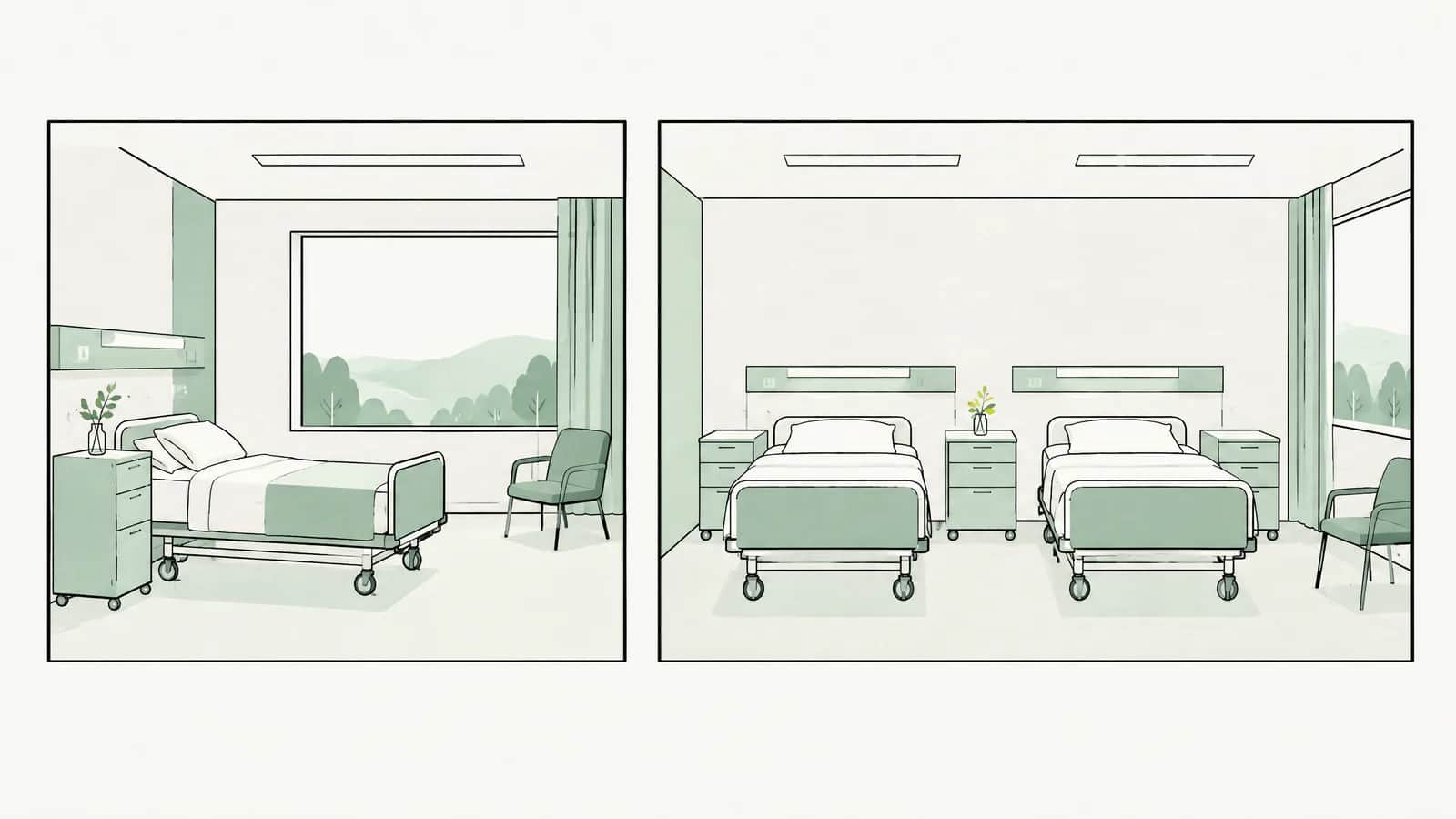
Single and double rooms are the hospital room categories that go beyond basic health insurance. Basic health insurance pays for your stay in the general ward. There you usually share the room with other patients, and the hospital decides which physician treats you.
If you want a room to yourself or shared with only one other person, you need supplementary hospital insurance. In Switzerland, two levels have become established:
- Semi-private: double room and free choice of physician in hospital. More in the entry semi-private ward.
- Private: single room and free choice of physician. More in the entry privately insured.
These terms are not defined by law. Each insurer sets out exactly what the cover includes in its terms and conditions. Besides these fixed levels, there are flexible products where you only decide which room you want when you are admitted to hospital, and pay a retention fee depending on your choice. They are often called flex hospital insurance.
It is important to draw the line with basic health insurance. Basic health insurance is compulsory, the insurer must accept you, and the benefits are the same at every insurer. Supplementary hospital insurance is voluntary, is governed by the Insurance Contract Act (ICA), and the insurer may turn you down.
How it works
When you take out semi-private or private hospital insurance, you fill in an application with a health questionnaire. You must answer these questions truthfully and completely. The insurer then decides whether to accept you, whether to add a reservation for certain conditions, or whether to reject you. Because the risk increases with age, the premium generally depends on your entry age or your current age.
When you are in hospital, the hospital bills in two parts. The share that treatment in the general ward would cost is paid by basic health insurance and your canton of residence. The additional costs for the room, comfort and the fees of the physician you chose are paid by the supplementary insurance, to the extent its terms provide for this.
Before a planned admission, the hospital or the insurer often obtains a cost approval. That way you know in advance whether the supplementary insurance will cover the additional costs. In an emergency, this is done afterwards.
You can cancel supplementary hospital insurance by ordinary notice to the end of the third year or any subsequent year, with three months’ notice. The insurer has no ordinary right to cancel supplementary health insurance and may not cancel it after a claim either. You can switch your basic health insurance independently, without giving up your supplementary insurance.
Legal basis
Under Art. 25 para. 2 let. e KVG, the benefits of basic health insurance include a hospital stay at the standard of the general ward. A single or double room is therefore not a mandatory benefit.
Art. 2 para. 2 KVAG allows health insurers to offer, in addition to basic health insurance, supplementary insurance that is governed by the Insurance Contract Act. The duty of disclosure when the contract is concluded is governed by Art. 4–6 ICA: if you fail to disclose a significant risk factor, the insurer can cancel the contract. Art. 35a para. 1 ICA allows ordinary cancellation to the end of the third or any subsequent year with three months’ notice. Under Art. 35a para. 4 ICA, in supplementary insurance to social health insurance, the ordinary right to cancel and the right to cancel after a claim belong only to you as the policyholder. Supplementary insurance is supervised by FINMA.
Example: four days in hospital, three options
Nina is 41, has the standard deductible of CHF 300 and needs to spend four nights in hospital in 2026 for a planned operation. The additional costs for the room and the physicians’ fees are assumed for the calculation; the deductible, retention fee and hospital contribution are the statutory amounts. The hospital contribution of CHF 15 applies per day excluding the day of discharge, so here for four days.
| General ward | Double room without supplementary insurance | Double room with semi-private supplementary insurance | |
|---|---|---|---|
| Basic health insurance and canton | General ward tariff | General ward tariff | General ward tariff |
| Additional costs for room and physicians’ fees | none | CHF 2,400 paid by Nina | Supplementary insurance, according to its terms |
| Deductible and retention fee | at most CHF 1,000 | at most CHF 1,000 | at most CHF 1,000 |
| Hospital contribution 4 × CHF 15 | CHF 60 | CHF 60 | CHF 60 |
Nina pays the supplementary insurance premium every month, even in years without a hospital stay. Whether it is worth it depends on how much the room and the choice of physician are worth to her, not just on the bill.
What this means for you
First ask yourself what you really want in hospital: peace and quiet in your own room, the choice of physician, or both. For the medical treatment itself, the room category makes no difference; basic health insurance covers all necessary mandatory benefits.
- Take it out early if you want it. Because health questions are asked, signing up is easiest when you are young and in good health.
- Compare terms. Check whether the whole of Switzerland is covered, which hospitals are excluded and whether a retention fee applies. You can compare offers under compare supplementary insurance.
- Look at basic health insurance separately. You can switch basic health insurance every year without giving up your supplementary insurance. You will find the 2026 premiums of all insurers in the premium calculator and an overview of the insurers under health insurers.
If you already have supplementary hospital insurance, do not cancel it before a new insurer has accepted you in writing.
Common mistakes
- Believing basic health insurance pays part of the room. It pays the general ward tariff; it does not cover the additional costs.
- Answering health questions inaccurately. Withheld information can lead the insurer to cancel the contract and refuse benefits.
- Cancelling the old policy too early. Without acceptance by the new insurer, you risk ending up without supplementary insurance.
- Confusing semi-private and private. Semi-private usually means a double room, private a single room. The terms of your policy are decisive.
You will find more terms on hospitals and supplementary insurance in the glossary.
Frequently asked questions
Does basic health insurance pay for a single room?
No. Basic health insurance covers your stay in the general ward, usually in a room with several beds. For a single room, you need private supplementary hospital insurance or you pay the surcharge yourself.
What is the difference between semi-private and private?
Semi-private usually means a double room and free choice of physician in hospital; private means a single room and free choice of physician. The exact benefits, for example whether the whole of Switzerland is covered, are set out in the insurer’s terms and conditions.
Can I get a single room without supplementary insurance?
Many hospitals offer a paid upgrade if a room is free. You then pay the additional costs for the room and the physicians’ fees yourself. Ask for a written cost estimate before you are admitted.
When can I cancel supplementary hospital insurance?
By ordinary notice to the end of the third year of insurance or any subsequent year, with three months’ notice, unless the contract provides for a shorter period. The insurer itself has no ordinary right to cancel supplementary health insurance.
Related terms
- Privately insuredIn Switzerland, being privately insured means that you have supplementary hospital insurance for the private ward. It pays for additional hospital benefits that basic health insurance does not cover, usually a single room and free choice of doctor. Basic health insurance only covers the general ward of a hospital on the Hospital List, under Art. 25 and 41 KVG.
- Semi-private wardSemi-private (halbprivat) is a level of supplementary hospital insurance that gives you a two-bed room in hospital and usually the choice of hospital doctor. Basic health insurance only pays for the general ward, in a listed hospital together with the canton, which pays at least 55%. The additional costs of the semi-private ward are covered by supplementary insurance under the Insurance Contract Act (ICA).
- Supplementary hospital insuranceSupplementary hospital insurance is voluntary insurance under the Insurance Contract Act (ICA) that pays more than basic health insurance when you need inpatient hospital treatment: free choice of hospital anywhere in Switzerland, a two-bed or single room or your choice of doctor. Basic health insurance only covers the general ward of a listed hospital, and you pay CHF 15 per day in hospital.
- General wardThe general ward is the standard that basic health insurance pays for during a hospital stay: treatment, care and accommodation in a multi-bed room of a listed hospital, by the medical team the hospital assigns to you. You pay the deductible, a 10% retention fee and CHF 15 a day. Only supplementary insurance covers a single room and a free choice of doctor.
- Flex hospital insuranceFlex hospital insurance is supplementary hospital insurance under which you only decide before each hospital admission whether you want to stay in the general, semi-private or private ward. If you choose a higher ward, you pay an agreed co-payment, for example 20% up to a maximum of CHF 2,000 for semi-private. The details are set out in each product’s general terms and conditions.
Sources
- Federal Health Insurance Act (KVG), Art. 25Art. 25 para. 2 let. e KVGfedlex.admin.ch
- Insurance Contract Act (ICA), Art. 35aArt. 35a ICAfedlex.admin.ch
- Health Insurance Supervision Act (KVAG), Art. 2Art. 2 para. 2 KVAGfedlex.admin.ch
- Insurance Contract Act (ICA), Art. 4–6Art. 4–6 ICAfedlex.admin.ch
- FINMA: Authorised institutions, individuals and productsfinma.ch