Key points at a glance
- Basic health insurance only pays for aids and appliances that are on the MiGeL and have been prescribed by a doctor (Art. 20 KLV).
- A maximum reimbursement amount applies to each product; if the product costs more, you pay the difference yourself (Art. 24 para. 3 KLV).
- Basic health insurance only reimburses glasses and contact lenses up to the 18th birthday, with at most CHF 180.67 per year (MiGeL, as of 01.07.2026).
- If old-age and survivors’ insurance (AHV), invalidity insurance (IV), accident insurance or military insurance is responsible, the health insurer pays nothing towards it, not even the remaining costs.
- The deductible and the retention fee also apply to aids and appliances.
What are aids and appliances?
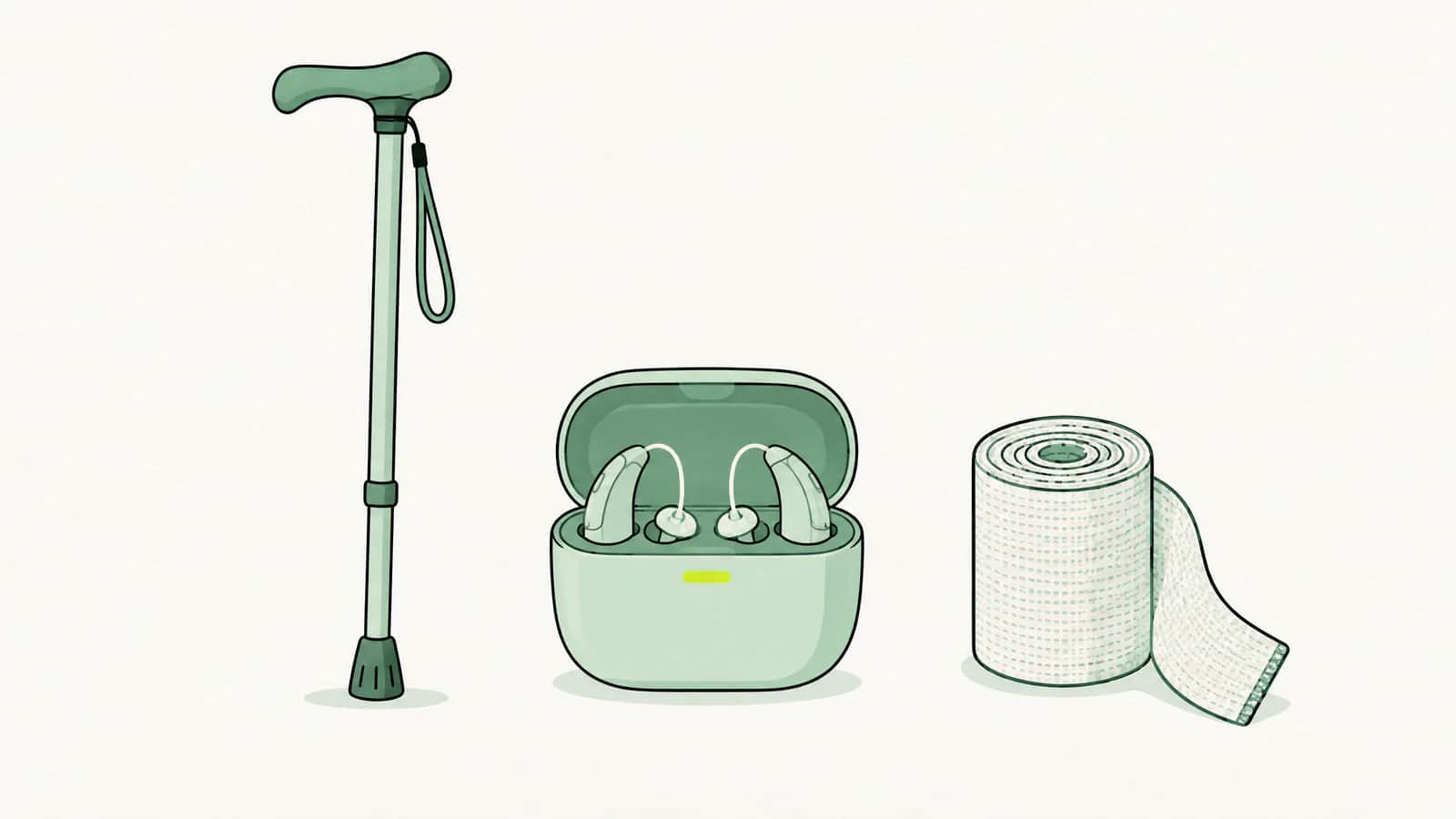
Aids and appliances are items that help you treat an illness, relieve its effects or monitor a treatment. In Swiss health insurance law they are called “means and objects” (Mittel und Gegenstände). Examples are crutches, compression stockings, dressings, incontinence aids, blood glucose test strips, inhalers or spectacle lenses for children.
What matters is that you use the aid yourself, alone or with the help of someone close to you, or that it is used as part of care at home or in a nursing home. Material that a doctor uses up during a treatment in the practice is not an aid in this sense; it is included in the tariff for the treatment.
Which aids and appliances basic health insurance pays for, and up to what amount, is set out exhaustively in the Aids and Appliances List (MiGeL) of the Federal Office of Public Health (FOPH). Basic health insurance does not pay for anything that is not on the list. Supplementary insurance can cover more; this is governed by its policy conditions under the Insurance Contract Act.
The distinction from other social insurances is important. Invalidity insurance covers, among other things, walking aids, hearing aids, glasses and contact lenses, orthopaedic footwear, orthoses and prostheses. Old-age and survivors’ insurance (AHV) pays, for example, for hearing aids, orthopaedic shoes and magnifying glasses, and after an accident accident insurance is responsible. The health insurer only steps in if none of these insurances is liable to pay.
How it works
For basic health insurance to reimburse an aid, three conditions must be met:
- The product is on the MiGeL. The list is organised by product group, for example “walking aids”, “hearing aids” or “visual aids”. Many items have a limitation, such as a minimum duration or an age limit.
- A doctor has prescribed it. For certain products, a prescription from a chiropractor is also sufficient.
- An authorised supplier dispenses it. The supplier needs a cantonal authorisation and a contract with your insurer, for example a pharmacy or a medical supply shop.
For each product, the MiGeL sets a maximum reimbursement amount (HVB). This is the most the insurer will pay, including VAT. If your product costs more, you pay the difference yourself. Expensive devices that can be reused are generally rented out by the supplier; the rent then includes fitting and maintenance.
Some amounts apply “per year”. This does not mean per calendar year, but for 365 days from the first purchase. Children’s glasses bought on 31 October can be reimbursed again in November of the following year at the earliest. Other amounts apply “per year (pro rata)” to consumables that are used continuously.
The insurer settles the aid like any other benefit. So you first pay your deductible and then a 10% retention fee up to the annual maximum. The difference above the HVB is not part of this and is not counted anywhere.
Legal basis
Under Art. 25 para. 2 let. b of the Federal Health Insurance Act (KVG), basic health insurance covers the means and objects prescribed by a doctor that serve for examination or treatment. Art. 52 para. 1 let. a no. 3 KVG instructs the Federal Department of Home Affairs to determine the obligation to pay benefits and the extent of reimbursement, and under Art. 52 para. 3 KVG the items may be charged at most at these rates.
The details are set out in the Health Care Benefits Ordinance (KLV). Art. 20 KLV describes which items are reimbursed: prescribed by a doctor, dispensed by a supplier under Art. 55 of the Health Insurance Ordinance (KVV) and used by you yourself or with the help of a person not involved in a professional capacity, or used as part of nursing care. Art. 20a KLV refers to the list in Annex 2, which the FOPH publishes on its website. Art. 24 KLV governs the maximum reimbursement amounts: if the price exceeds the amount, the difference is borne by the insured person (para. 3); the reimbursement can be set as a purchase price or a rental price (para. 4). Art. 64 KVG applies to the co-payment.
Example: crutches after an operation
Marco is 52, has had a knee operation and needs to take weight off his leg for several weeks. His doctor prescribes crutches with an anatomical grip. The MiGeL (as of 01.07.2026) sets a maximum reimbursement amount of CHF 60.22 per pair for these, with the limitation that weight relief of at least one month is necessary. Let us assume that the medical supply shop charges CHF 75.00 for its model.
| Item | Amount |
|---|---|
| Price of the crutches | CHF 75.00 |
| Maximum reimbursement amount MiGeL | CHF 60.22 |
| Difference that Marco always pays himself | CHF 14.78 |
| Amount processed through basic health insurance | CHF 60.22 |
If Marco chooses a model with an ergonomic grip, for which the MiGeL provides CHF 35.13 and to which no limitation on the duration of weight relief applies, the calculation changes accordingly.
What this means for you
Ask about the maximum reimbursement amount before you buy. Pharmacies and medical supply shops know the MiGeL items and can tell you whether a product is reimbursed and how much you pay yourself. Always ask for a doctor’s prescription; without it, the insurer pays nothing.
For larger aids, first clarify which insurance is responsible. After an accident it is accident insurance, in the case of invalidity often invalidity insurance (IV), and for hearing aids at retirement age old-age and survivors’ insurance (AHV). You can read more about this under hearing aid. Only if none of them pays does basic health insurance come into play.
For adults’ glasses, basic health insurance only helps in special cases. Many supplementary insurance policies pay a glasses contribution; whether this is worth it depends on the premium and the benefit. Basic health insurance benefits are the same at every insurer; if you want to save on premiums, compare them in the premium calculator. You can find key figures and contact details for the insurers in the health insurer profiles.
Common mistakes
- Buying without a prescription. Without a doctor’s prescription, basic health insurance does not reimburse any aid, even if it is on the MiGeL.
- Forgetting the difference above the maximum amount. Whatever a product costs above the HVB, you pay yourself, and it does not count towards the deductible.
- Thinking the health insurer pays for everything. After an accident, accident insurance pays; for many aids, invalidity insurance (IV) or old-age and survivors’ insurance (AHV) pays. The health insurer does not cover any remaining costs that these insurances do not cover.
- Replacing children’s glasses too early. The amount of CHF 180.67 applies for 365 days from the last purchase, not per calendar year.
- Hoping for reimbursement without a receipt. Submit the invoice with the prescription; only then is the amount counted towards your deductible and retention fee.
We explain how we present benefits and sources under How we calculate.
Frequently asked questions
Which aids and appliances does health insurance pay for?
Basic health insurance pays for items and products that are on the FOPH’s MiGeL, have been prescribed by a doctor and come from a recognised supplier. These include, for example, crutches, dressings, incontinence aids or inhalers. Anything that is not on the list is not paid for.
Does health insurance pay for glasses?
For children and young people up to their 18th birthday, basic health insurance reimburses at most CHF 180.67 per year towards glasses or contact lenses, with a prescription from an eye doctor. For adults there are only contributions for certain illnesses; otherwise supplementary insurance may help.
Who pays for a hearing aid?
Hearing aids are mainly covered by old-age and survivors’ insurance (AHV), invalidity insurance (IV) or accident insurance. The health insurer only covers them if none of these insurances is responsible, and then according to its own tariffs.
Can I choose a more expensive model?
Yes. The insurer pays at most the maximum reimbursement amount from the MiGeL. You pay the difference to the price of the model you choose yourself, and it does not count towards your deductible or retention fee.
Related terms
- MiGeLThe MiGeL (Aids and Appliances List) is the federal list of medical products that basic health insurance pays for, such as crutches, blood glucose meters, dressings or breast pumps. For each product, it sets a maximum reimbursement amount. If a product costs more, you pay the difference yourself, plus your deductible and retention fee.
- Hearing aidA hearing aid amplifies sound for people with hearing loss. It is mainly paid for by invalidity insurance (IV), old-age and survivors’ insurance (AHV) or accident insurance, as a flat rate: IV pays CHF 840 for one device and CHF 1,650 for two. Basic health insurance only steps in if none of these insurances is responsible.
- Contribution towards glassesThe contribution towards glasses is the amount your health insurer pays towards spectacle lenses or contact lenses. Basic health insurance pays no more than CHF 180.67 per year for children and adolescents up to their 18th birthday, and for adults only in special medical cases. Anything beyond that is covered, at most, by supplementary outpatient insurance.
- Invalidity insuranceInvalidity insurance (IV) is the compulsory social insurance for people whose ability to earn a living is permanently limited because of a congenital disorder, illness or accident. It first pays for integration measures and aids and appliances, and only then a pension from a degree of invalidity of 40%. For congenital disorders it covers treatment up to age 20, ahead of the health insurer.
- PodiatryPodiatry is medical foot care provided by trained podiatrists. Basic health insurance only pays for it for people with diabetes who are at risk of diabetic foot syndrome, on a doctor’s prescription and for 4 to 6 sessions per year (Art. 11c KLV). You pay for other foot care yourself or through supplementary insurance.
- Red Cross driver serviceThe Red Cross driver service takes people with reduced mobility to doctor’s appointments and therapy sessions and back home again. Volunteers from the cantonal Red Cross associations drive, and each trip is charged, in the canton of Zurich around CHF 8 per trip plus CHF 0.95 per kilometre. Whether your health insurer pays anything is decided case by case.
Sources
- Health Care Benefits Ordinance (KLV), Art. 20, 20a and 24Art. 20–24 KLVfedlex.admin.ch
- Federal Health Insurance Act (KVG), Art. 25Art. 25 para. 2 let. b KVGfedlex.admin.ch
- Federal Health Insurance Act (KVG), Art. 52Art. 52 KVGfedlex.admin.ch
- Federal Health Insurance Act (KVG), Art. 64Art. 64 KVGfedlex.admin.ch
- Health Insurance Ordinance (KVV), Art. 55Art. 55 KVVfedlex.admin.ch
- FOPH: Aids and Appliances List (MiGeL), as of 01.07.2026 (German; no English version, also available in French and Italian)bag.admin.ch