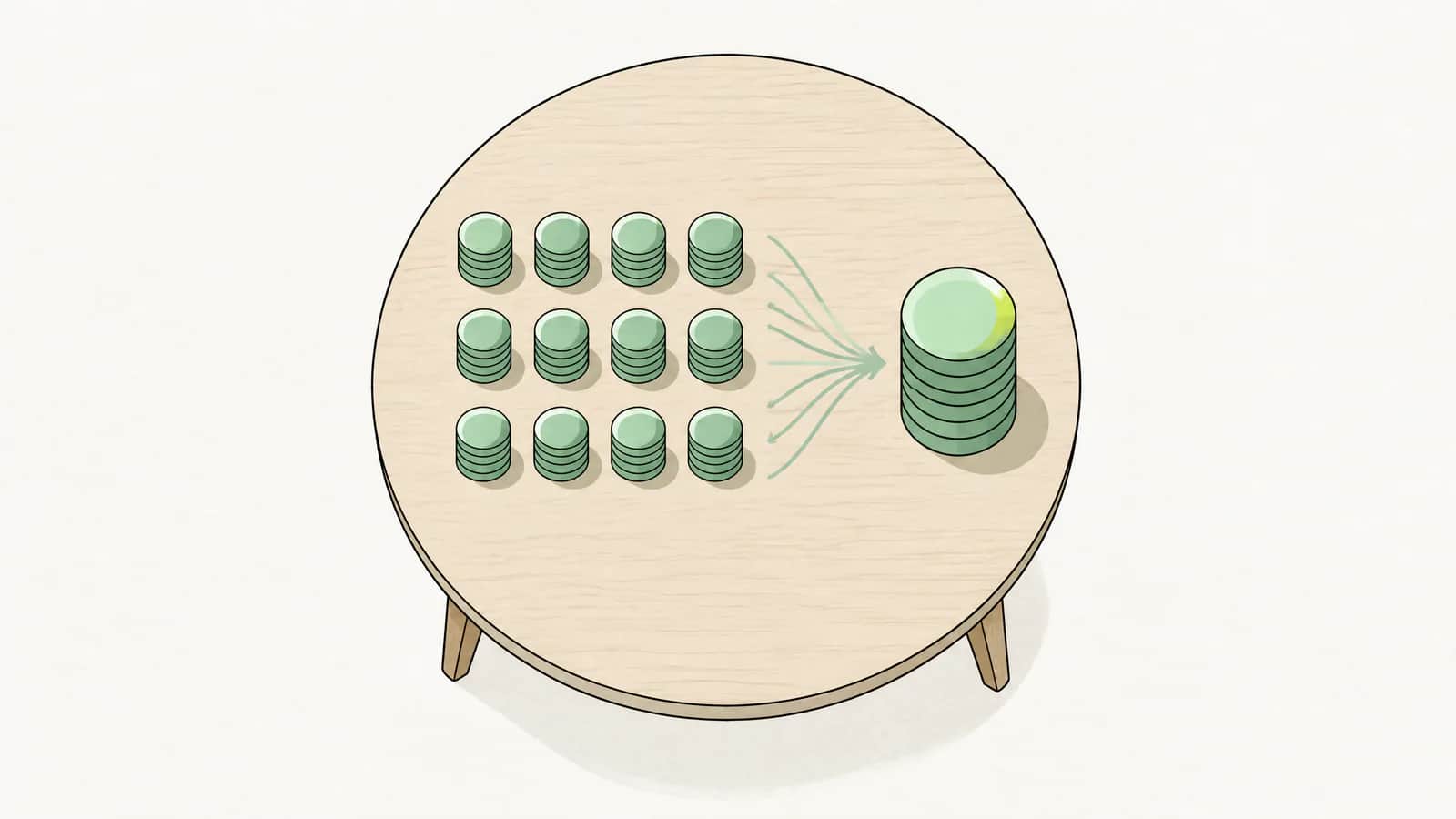
A discount for annual payment is voluntary; the law only requires the premium to be paid in advance and, as a rule, monthly. According to their own information, Helsana and SWICA, for example, give 0.5 %, KPT 1 % and Visana 2 %. On an annual premium of CHF 7,644, this is CHF 38.22 to CHF 152.88.
Key points at a glance
- The basic health insurance premium must be paid in advance and, as a rule, monthly; the law does not prescribe a discount (Art. 90 KVV).
- As of 25.09.2026, the insurers state on their websites: Helsana 0.5 % and SWICA 0.5 % for annual payment, KPT 1 % (six-monthly 0.5 %), Visana 2 % (six-monthly 1 %).
- The official FOPH premiums are monthly premiums without a discount.
- If you do not pay a premium that is due, you risk 5 % default interest per year (Art. 105a KVV) and can only switch insurer once you have paid in full (Art. 64a para. 6 KVG).
- Basel 2026, adults, CHF 300 deductible: the difference between the median and the cheapest premium is CHF 733.20 per year; a 1 % discount on the median brings CHF 76.44 (FOPH).
Annually or monthly: what the law says
The basic health insurance premium must be paid in advance and, as a rule, monthly (Art. 90 of the Health Insurance Ordinance, KVV). “As a rule” means that the insurer may also offer other payment intervals, but does not have to. Whether it rewards a longer payment period with a discount is up to the insurer. This discount is called a prepayment discount.
Important for any comparison: the premiums that the Federal Office of Public Health (FOPH) approves and publishes are monthly premiums without a discount. The premium calculator also shows these amounts. The discount only appears on your invoice. Unlike the discount for a higher deductible or for a GP or telemedicine model, it is not regulated by law.
This is how the usual intervals for premium payment compare:
| Interval | Due | Payments per year | Discount at the four insurers checked |
|---|---|---|---|
| monthly | every month in advance | 12 | no |
| quarterly | January, April, July, October | 4 | no |
| six-monthly | January and July | 2 | KPT and Visana |
| annually | January | 1 | all four |
Which insurers give a discount
There is no official list, because the discount is not part of the approved premium. We checked the information on the websites of four large insurers (retrieved on 25.09.2026):
| Insurer | six-monthly | annually | applies to |
|---|---|---|---|
| Helsana | not stated | 0.5 % | premium invoice |
| SWICA | not stated | 0.5 % | basic and supplementary insurance |
| KPT | 0.5 % | 1 % | basic and supplementary insurance |
| Visana | 1 % | 2 % | premium payment, if due on 1 January or on 1 January and 1 July |
The conditions differ in detail. KPT requires the annual invoice to be paid by 3 January and states timely prepayment as a condition. According to its table, Visana only grants the discount if payment is due on 1 January (annually) or on 1 January and 1 July (six-monthly), not for the later due dates in March and September. The rates can change at any time. What counts is the information on your premium invoice and from your insurer. For all other insurers, you will find contact details and key figures in the health insurer profiles.
Step by step: switching to annual payment
- Ask about the discount. Check your premium invoice or the customer portal, or ask your insurer whether it gives a discount, how much and for which insurance policies.
- Clarify the date. Insurers usually only change the payment interval on certain dates. Helsana, for example, states 1 January or 1 July for switching from six-monthly to monthly payment. It sends invoices one month in advance and does not make retroactive changes. So switch in good time.
- Check your reserves. The annual premium is due in January. Your deductible also starts again in the same month. Add both together before you switch.
- Change the interval. In the customer portal, by phone or in writing. When you switch insurer, you choose the interval directly in the application.
- Pay on time. If you pay late, the discount may be lost. With direct debit or standing approval in eBill, you will not miss the date.
What the discount is worth in francs
Premiums 2026, municipality of Basel (canton without premium regions), adults born in 1985, with accident cover; source FOPH. The median monthly premium of all 117 offers with a CHF 300 deductible is CHF 637.00, so the annual premium is CHF 7,644.00. The table converts the four insurers’ discount rates to this annual premium:
| Discount | Saving per year | Effective annual premium |
|---|---|---|
| 0 % | CHF 0.00 | CHF 7,644.00 |
| 0.5 % | CHF 38.22 | CHF 7,605.78 |
| 1 % | CHF 76.44 | CHF 7,567.56 |
| 2 % | CHF 152.88 | CHF 7,491.12 |
For comparison: the cheapest offer in Basel with the same deductible costs CHF 575.90 per month. The difference between the median and the cheapest offer is CHF 61.10 per month or CHF 733.20 per year, almost five times as much as a 2 % discount. With a CHF 2,500 deductible, the median is CHF 508.70 per month; there, a 1 % discount brings CHF 61.04 per year.
Sample calculation: discount, switching insurer or both
Example with fictitious people. Andrea is 41, lives in Basel and pays the median premium of CHF 637.00 per month with a CHF 300 deductible. She is considering switching to annual payment.
The example shows the order: first the insurer and the model, then the payment method. The benefits of basic health insurance are the same at all insurers. The article What does health insurance really cost? explains which costs are added to the premium.
When annual payment pays off and when it does not
More likely to pay off if:
- your insurer gives a discount and you have had it confirmed in writing;
- you can pay the annual premium in January without difficulty and also have reserves for the deductible;
- you are likely to stay with this insurer for the whole year.
Less likely to pay off if:
- your insurer does not give a discount: then you are only tying up money with nothing in return;
- your budget is tight: an unpaid premium leads to a reminder and blocks a switch of insurer;
- you receive a premium subsidy and the amount has not yet been set: the canton pays the subsidy to the insurer, and your invoice falls accordingly. The page Premium subsidy shows whether you are entitled.
What applies in the event of late payment
If you do not pay a premium that is due, the insurer must send you a reminder no later than three months after the due date (Art. 105b para. 1 KVV). This is followed by a demand for payment with a 30-day grace period and debt enforcement (Art. 64a para. 1 of the Federal Health Insurance Act, KVG). The insurer may charge 5 % default interest per year on premiums that are due (Art. 105a KVV). As long as premiums are outstanding, you cannot switch insurer (Art. 64a para. 6 KVG). With an annual invoice, the outstanding amount is twelve times as large as with a monthly invoice.
Special cases
- Leaving during the year: If you move abroad or switch insurer at the end of June (Art. 7 para. 1 KVG), you receive a refund of the premium paid in advance for the months that follow. How the insurer treats the discount is up to the insurer. If it does not refund overpaid premiums of more than CHF 3,000 within six months, it owes you 5 % interest (Art. 90a KVV).
- Premium increase: The insurer must notify you of a new premium at least two months before it takes effect (Art. 7 para. 2 KVG). The new premiums apply from 1 January; an annual premium paid in January therefore covers the whole year at the same rate.
- Families: If several people are on one invoice, the interval usually applies to all of them. For children, the parents owe the premium until the end of the month in which the child reaches the age of majority (Art. 61a KVG).
- Supplementary insurance: The Insurance Contract Act (ICA) applies here. In case of doubt, the premium is due for a whole year in advance (Art. 19 ICA), unless the contract provides otherwise. Whether there is a discount is set out in the general terms and conditions; what counts is the information from your insurer.
Common mistakes
- Giving the discount more weight than the premium. Even a 2 % discount brings less than comparing insurers if your premium is above the median.
- Paying the annual invoice too late. Then the discount is lost and a reminder may follow.
- Comparing FOPH premiums with your invoice. The official premiums do not include a discount. Work your invoice back before you compare.
- Paying in advance without reserves. In January, the annual premium and the first bills up to the deductible come together.
- Switching interval before switching insurer. If you are planning to switch insurer on 1 January, decide on the insurer first. Your notice of cancellation must arrive by 30 November; the deadline calculator shows all dates.
You will find other ways to save in the section Saving money, for example excluding accident cover for employees. We explain how we evaluate premiums under How we calculate.
Frequently asked questions
Is there a discount if I pay my health insurance annually?
With some insurers, yes. The discount is voluntary and, among the insurers whose information we checked, ranges from 0.5 % to 2 % of the premium. Other insurers give none or do not state it publicly; ask your insurer.
Do I have to pay my health insurance monthly?
No. The ordinance sets monthly payment as the rule, but insurers usually also offer quarterly, six-monthly or annual payments (Art. 90 KVV). In any case, the premium is due in advance.
What happens to a premium paid in advance if I switch insurer?
Premiums for months after you leave belong to you; the insurer settles them and refunds them. How it treats the discount in doing so is up to the insurer. With the usual switch on 1 January, the question does not arise, because the new insurer’s annual premium only becomes due then.
Does the discount also apply to supplementary insurance?
According to their own information, yes at SWICA and KPT; at other insurers, it depends on the conditions. In supplementary insurance, under Art. 19 ICA the premium is in any case due one year in advance in case of doubt, unless the contract provides otherwise.
Sources
- Health Insurance Ordinance (KVV), Art. 90Art. 90 KVVfedlex.admin.ch
- Health Insurance Ordinance (KVV), Art. 90aArt. 90a KVVfedlex.admin.ch
- Health Insurance Ordinance (KVV), Art. 105a and 105bArt. 105a–105b KVVfedlex.admin.ch
- Federal Health Insurance Act (KVG), Art. 61Art. 61 para. 1 KVGfedlex.admin.ch
- Federal Health Insurance Act (KVG), Art. 61aArt. 61a KVGfedlex.admin.ch
- Federal Health Insurance Act (KVG), Art. 64aArt. 64a paras 1 and 6 KVGfedlex.admin.ch
- Federal Health Insurance Act (KVG), Art. 7Art. 7 paras 1 and 2 KVGfedlex.admin.ch
- Insurance Contract Act (ICA), Art. 19Art. 19 ICAfedlex.admin.ch
- Helsana: Change payment frequency (retrieved 15.10.2026)helsana.ch
- SWICA: Options for paying your premiums (retrieved 15.10.2026)swica.ch
- KPT: Save on health insurance, as of 01.09.2026 (retrieved 15.10.2026)kpt.ch
- Visana: FAQs, payment intervals (retrieved 15.10.2026)visana.ch
- FOPH: Health insurance premiums 2026 (opendata.swiss)opendata.swiss
Read more
- Excluding accident cover: when you may do it and what it savesIf your employer insures you against accidents, you pay twice for the accident cover in your health insurance. How to exclude it, how much it saves and what you must report when your job ends.Saving money
- What does health insurance really cost? Premium plus deductible plus retention feeThe premium is only part of the bill. How to add the deductible, retention fee and hospital contribution, with three cost scenarios and real 2026 premiums.Saving money