Basic health insurance does not pay for a rollator: it is not in the Aids and Appliances List (MiGeL), which only lists crutches and height-compensation soles under walking aids. Invalidity insurance lends rollators, old-age insurance does not. After an accident, accident insurance pays; with supplementary benefits, possibly the canton.
Key points at a glance
- Basic health insurance only pays for aids and appliances prescribed by a doctor that are in the MiGeL, at most up to the maximum reimbursement amount (Art. 20 and 24 KLV).
- Chapter 10 “Walking aids” of the MiGeL (edition of 01.07.2026) lists crutches and height-compensation soles, but no rollator.
- Invalidity insurance lends rollators and walking frames (HVI Annex no. 12.02); the list of aids of old-age insurance contains no rollator.
- If old-age, invalidity, accident or military insurance is responsible, basic health insurance pays nothing on top, not even the remaining costs (MiGeL, explanatory notes no. 2.3).
- People who receive supplementary benefits are reimbursed for the costs of aids and appliances under the rules of their canton (Art. 14 para. 1 let. f ELG).
What basic health insurance pays
Basic health insurance pays for aids and appliances prescribed by a doctor that serve examination or treatment (Art. 25 para. 2 let. b of the Federal Health Insurance Act, KVG). Which ones, and up to what amount, is set out exhaustively in the Aids and Appliances List, the MiGeL (Art. 52 para. 1 let. a no. 3 KVG, Art. 20a of the Health Care Benefits Ordinance, KLV). Basic health insurance does not pay for anything that is not on the list. This page is based on the edition of 01.07.2026.
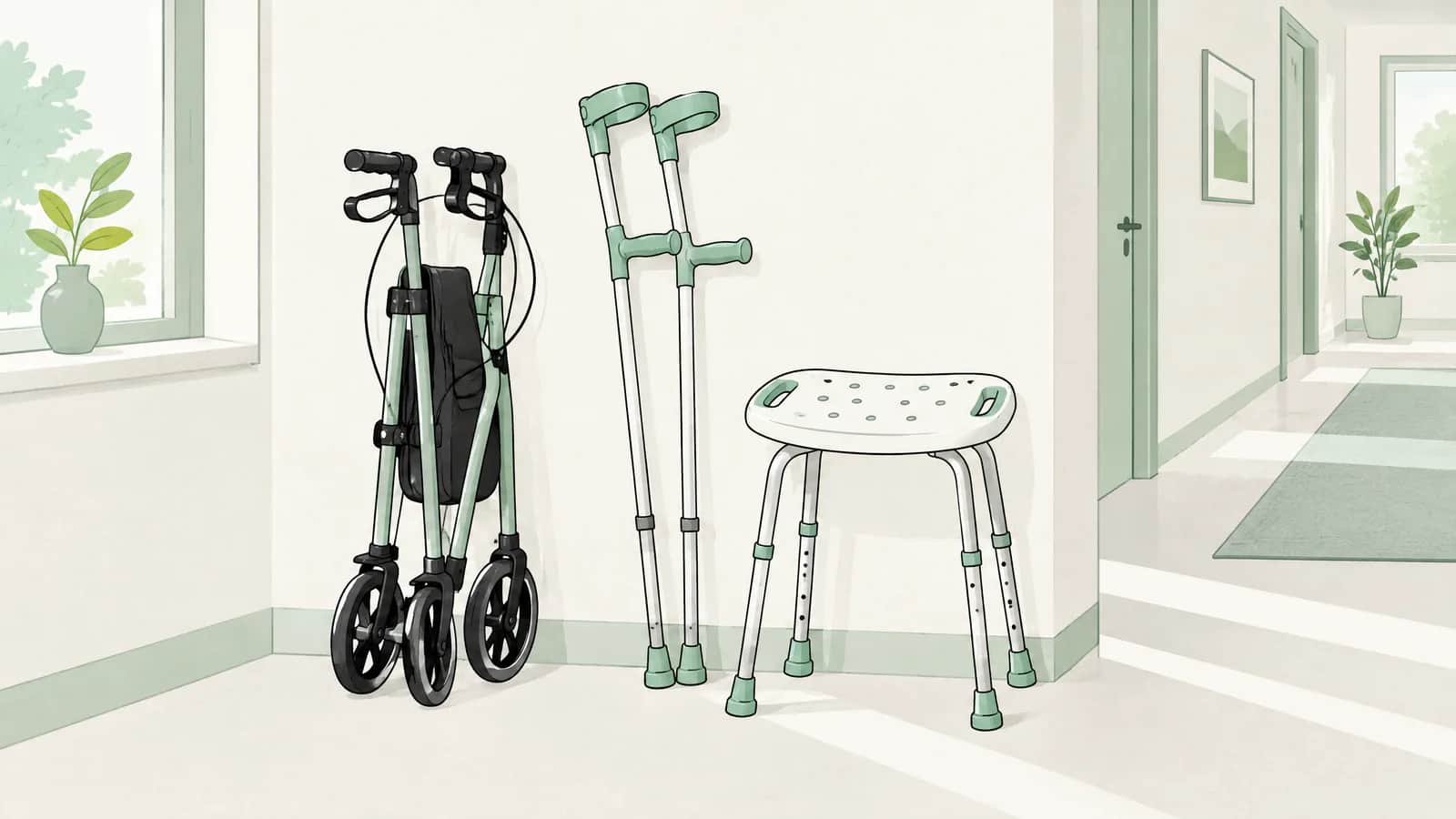
In chapter 10, the MiGeL describes walking aids as aids that make walking possible after illness or an accident, or that take the weight off a leg during the healing and recovery phase. For walking aids in everyday life outside this phase, it expressly refers to invalidity insurance. The list is correspondingly short:
| Aid or appliance | In the MiGeL? | Maximum reimbursement amount (self-use) |
|---|---|---|
| Crutches for adults, ergonomic grip, purchase (item 10.01.01.00.1) | yes | CHF 35.13 per pair |
| Crutches for adults, anatomical or orthopaedic grip, purchase (item 10.01.01.01.1) | yes, only if the leg needs relief for at least 1 month | CHF 60.22 per pair |
| Children’s crutches, purchase (item 10.01.01.02.1) | yes | CHF 44.16 per pair |
| Children’s crutches, rental (item 10.01.01.02.2) | yes, at most 6 weeks, then ownership | CHF 1.15 per day |
| Height-compensation sole for casts and orthoses (item 10.02.01.00.1) | yes, 1 per case of treatment | CHF 39.14 |
| Rollator, walking frame | no | – |
| Wheelchair | no | – |
| Care bed, shower stool | no | – |
The maximum reimbursement amount is the most the insurer pays. If the product costs more, you pay the difference yourself (Art. 24 para. 3 KLV). The normal co-payment applies to the reimbursed part: first the deductible, then a 10 % retention fee (Art. 64 para. 2 KVG). The glossary entry aids and appliances explains the list in more detail.
The order of priority is important. If old-age, invalidity, accident or military insurance is responsible for an aid or appliance, that insurance settles the claim. Basic health insurance then provides no additional benefits and does not cover any share of the costs that, for example, old-age insurance does not reimburse (MiGeL, explanatory notes no. 2.3).
What supplementary insurance pays
For a rollator or other aids and appliances outside the MiGeL, a voluntary supplementary outpatient insurance comes into question. It is governed by the Insurance Contract Act (ICA); the law does not prescribe any contribution towards aids and appliances. Possible provisions in the general terms and conditions:
- a percentage or a fixed amount towards aids and appliances that are not in the MiGeL,
- a contribution towards rental instead of purchase,
- a maximum amount per year or per aid,
- a doctor’s prescription as a requirement,
- an exclusion if a social insurance such as invalidity insurance would be responsible.
Whether your contract includes a rollator is only set out in the general terms and conditions. We are building a comparison of supplementary products under Supplementary insurance. What counts are the general terms and conditions and the information from your insurer.
Conditions
Who pays for a rollator or other aid depends on why and for how long you need it and how old you are.
- Basic health insurance, MiGeL only: The aid must be in the MiGeL, prescribed by a doctor and come from an approved supplier, such as a pharmacy or a medical supply shop (Art. 20 KLV). For rollators, this condition is never met.
- Invalidity insurance: Invalidity insurance (IV) provides aids and appliances that you need because of a disability in order to get around, stay in contact with your surroundings or look after yourself (Art. 21 para. 2 of the Federal Act on Invalidity Insurance, IVG; Art. 2 HVI). Its list includes rollators and walking frames (Annex no. 12.02), wheelchairs (no. 9), toilet-shower units, patient lifts and electric beds (no. 14.01 to 14.03), all on loan. They are provided in a simple and appropriate design (Art. 21 para. 3 IVG). You register with the IV office of your canton.
- End of the IV entitlement: The entitlement to integration measures from invalidity insurance ends when you draw your full old-age pension early, at the latest at the end of the month in which you reach the reference age (Art. 10 para. 3 IVG). You keep aids and appliances you received from invalidity insurance before then to the same extent, as long as the conditions are met (Art. 4 HVA).
- Old-age insurance (AHV): From retirement age, old-age insurance only provides the aids and appliances on its own exhaustive list (Art. 2 para. 1 HVA). It does not include a rollator. Towards a wheelchair without a motor that is likely to be needed permanently, it pays CHF 900, at most every five years (HVA Annex no. 9.51).
- Accident insurance: If you need the aid because of an accident, you are entitled to aids and appliances that compensate for physical damage or loss of function (Art. 11 of the Accident Insurance Act, UVG). Accident insurance then settles the claim, not the health insurer.
- Supplementary benefits: If you receive annual supplementary benefits, the canton reimburses proven costs for aids and appliances (Art. 14 para. 1 let. f of the Federal Act on Supplementary Benefits, ELG). The canton decides which costs (Art. 14 para. 2 ELG).
Sample calculation
Example with fictitious people and assumed prices. Hanna, 79, receives an old-age pension and needs a rollator for everyday life after a long illness. We assume a price of CHF 300. Her daughter Eva, 52, has been prescribed crutches with an anatomical grip after a knee operation, because she has to keep the weight off her leg for six weeks; the medical supply shop charges an assumed CHF 75. Eva has already used up her deductible for the year. The maximum reimbursement amounts come from the MiGeL as of 01.07.2026.
| Step | Hanna, rollator | Eva, crutches |
|---|---|---|
| Price (assumed) | CHF 300.00 | CHF 75.00 |
| In the MiGeL? | no | yes, CHF 60.22 per pair |
| Amount reimbursed by basic health insurance | CHF 0.00 | CHF 60.22 |
| 10 % retention fee | – | CHF 6.02 |
| Paid out by basic health insurance | CHF 0.00 | CHF 54.20 |
| Difference above the maximum amount | – | CHF 14.78 |
| Own share | CHF 300.00 | CHF 20.80 |
How to proceed
- Clarify the cause: Illness, accident or permanent disability? This determines which insurance is responsible.
- Get a prescription: Have a doctor prescribe the aid. This is compulsory for MiGeL products and usually helpful for invalidity insurance, accident insurance and supplementary insurance.
- For a permanent need, involve invalidity insurance: Before retirement age, register with the IV office before you buy. Invalidity insurance lends rollators.
- Consider renting instead of buying: For a short period, it is worth asking the supplier about rental, even if you pay yourself.
- Send the invoice to the right place: Basic health insurance only for MiGeL products, otherwise the supplementary benefits office or supplementary insurance.
Common mistakes
- Submitting the rollator to basic health insurance. It is not in the MiGeL; the insurer has to refuse it.
- Buying first, then asking invalidity insurance. Invalidity insurance lends rollators. Clarify your entitlement before buying.
- Expecting the health insurer to cover the remaining costs. If old-age or invalidity insurance pays part, basic health insurance does not cover the rest.
- Forgetting the difference above the maximum amount. You always pay this yourself, and it does not count towards the deductible.
Other help in everyday life is described in the guides Household help and Occupational therapy, and the hearing aid as another aid provided by old-age and invalidity insurance in the guide Hearing aid. You will find all benefits in the overview What does health insurance cover?; you can compare premiums in the premium calculator and key figures in the health insurer profiles.
Frequently asked questions
Does health insurance pay for a rollator?
Basic health insurance does not, because the rollator is not in the MiGeL. Up to the reference age for old-age insurance or until you draw your full old-age pension early, invalidity insurance can lend you a rollator if you need it because of a disability. Some supplementary insurances contribute under their general terms and conditions.
Does old-age insurance pay for a rollator?
No. The list of aids of old-age insurance does not include a rollator. If you received a rollator from invalidity insurance before reaching retirement age, you keep that entitlement to the same extent as long as the conditions are met (Art. 4 HVA).
Which walking aids does basic health insurance pay for?
The MiGeL (edition of 01.07.2026) lists crutches for adults and children, and height-compensation soles for casts and orthoses. It reimburses crutches with an ergonomic grip up to CHF 35.13 per pair, with an anatomical grip up to CHF 60.22, if the leg needs to be relieved for at least one month.
Who pays for the rollator if I receive supplementary benefits?
If you receive supplementary benefits, the canton reimburses proven costs for aids and appliances according to its own rules. Which aids and up to what amount you can find out from the supplementary benefits office of your canton.
Does health insurance pay for a wheelchair?
Basic health insurance does not; the MiGeL contains no wheelchairs. Invalidity insurance lends wheelchairs; old-age insurance contributes CHF 900 at most every five years towards a wheelchair without a motor that is likely to be needed permanently.
Sources
- Federal Health Insurance Act (KVG), Art. 25 General benefits in the event of illnessArt. 25 para. 2 let. b KVGfedlex.admin.ch
- Federal Health Insurance Act (KVG), Art. 52Art. 52 para. 1 let. a no. 3 and para. 3 KVGfedlex.admin.ch
- Health Care Benefits Ordinance (KLV), Art. 20–24 Aids and appliancesArt. 20, 20a, 24 KLVfedlex.admin.ch
- FOPH: Aids and Appliances List (MiGeL), edition of 01.07.2026, chapter 10 Walking aids (German)bag.admin.ch
- Federal Health Insurance Act (KVG), Art. 64 Co-paymentArt. 64 para. 2 KVGfedlex.admin.ch
- Federal Act on Invalidity Insurance (IVG), Art. 21 Aids and appliances (German, current version)Art. 10 para. 3 and Art. 21 IVGfedlex.admin.ch
- FDHA Ordinance on the Provision of Aids and Appliances by the Invalidity Insurance (HVI), Art. 2 and AnnexArt. 2 HVI, Annex no. 9, 12.02, 14fedlex.admin.ch
- FDHA Ordinance on the Provision of Aids and Appliances by the Old-Age Insurance (HVA), Art. 2 and 4, AnnexArt. 2 and 4 HVA, Annex no. 9.51fedlex.admin.ch
- Accident Insurance Act (UVG), Art. 11 Aids and appliancesArt. 11 UVGfedlex.admin.ch
- Federal Act on Supplementary Benefits to Old-Age, Survivors’ and Invalidity Insurance (ELG), Art. 14 Costs of illness and disabilityArt. 14 para. 1 let. f and para. 2 ELGfedlex.admin.ch
Read more
- Does Swiss health insurance pay for household help?Nursing care yes, housework no: basic health insurance strictly separates nursing care from help in the household. For household help, only supplementary insurance, supplementary benefits or your own budget come into question.What does health insurance pay for?
- Does health insurance pay for occupational therapy?With a doctor’s prescription, basic health insurance pays for occupational therapy, minus the deductible and retention fee. For congenital disorders up to age 20, invalidity insurance pays; after an accident, accident insurance pays.What does health insurance pay for?