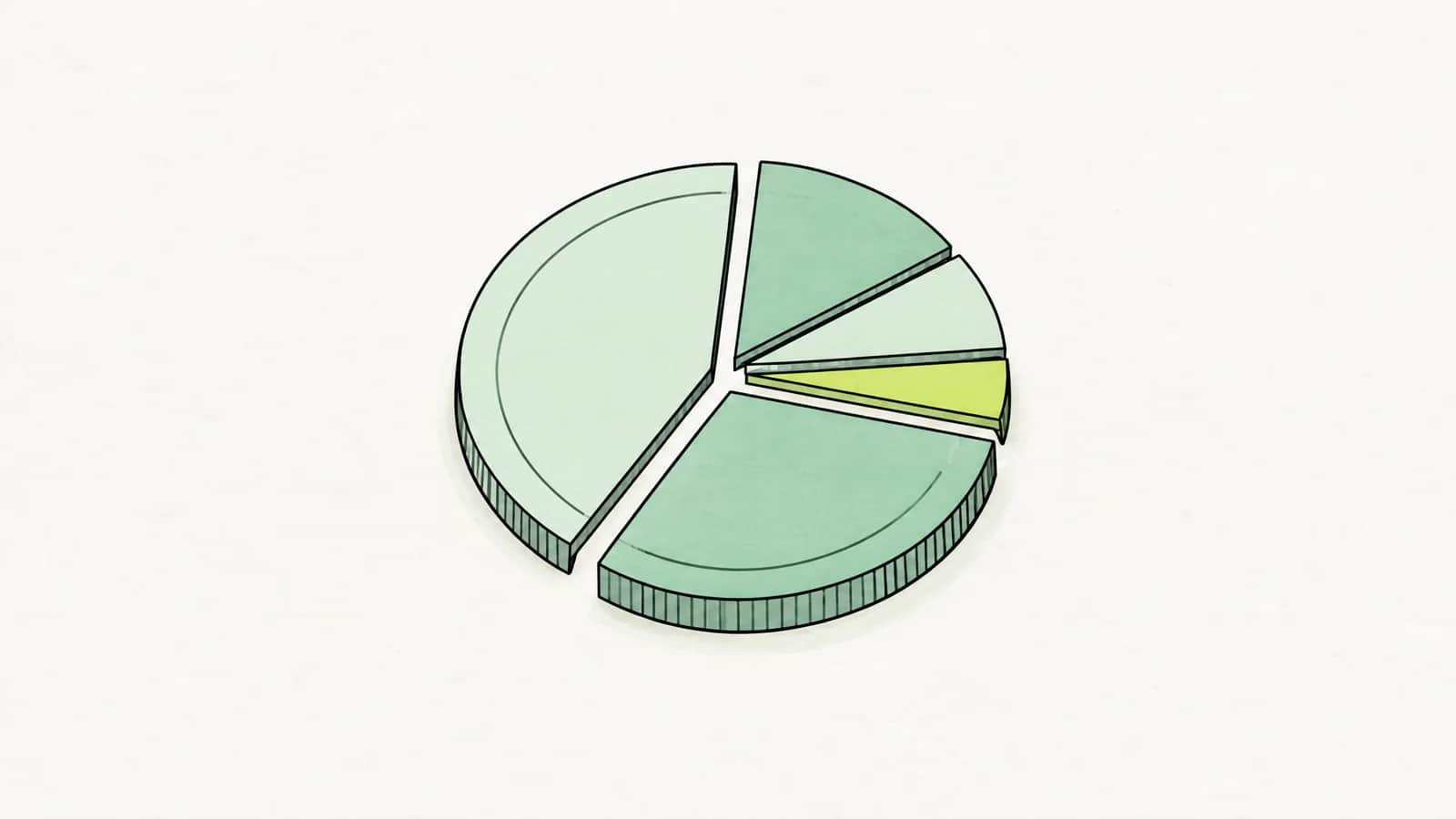
Of every CHF 100 of premium in basic health insurance, an average of CHF 94.90 went to treatment, medicines and care in 2024, and around CHF 4.50 to administration (FOPH). Profits for shareholders are not allowed: the funds of basic health insurance may only be used for basic health insurance (Art. 5 let. f KVAG). Surpluses go into reserves.
Key points at a glance
- In 2024, health insurers paid out 94.9 % of premiums as net benefits, on average CHF 4,059.88 of CHF 4,278.15 of premium per insured person (FOPH, supervisory data T 5.01).
- Administrative costs in 2024 were CHF 1.7 billion or CHF 193 per insured person per year, 4.6 % of premiums (FOPH, Priminfo).
- The funds of basic health insurance may only be used for basic health insurance (Art. 5 let. f KVAG); advertising and intermediary commissions must be shown separately in the annual accounts (Art. 19 para. 2 KVAG).
- Health insurers must publish the remuneration of their board and management in the annual report, with the total amount and the highest individual amount (Art. 21 KVAG).
- For a contract in basic health insurance, an intermediary may receive at most CHF 70 of variable remuneration per insured person (Art. 35b KVAV with Annex 2).
Where your premium goes
Basic health insurance is not a business in the usual sense. By law, health insurers do not pursue a profit-making purpose (Art. 2 para. 1 of the Health Insurance Supervision Act, KVAG), and all insurers may only use the funds of basic health insurance for its purposes (Art. 5 let. f KVAG). So there is no dividend from basic health insurance. Even so, not every franc ends up with the doctor or the pharmacy. The FOPH’s supervisory data show how premiums were distributed on average in 2024:
| Item | Per insured person per year | Share of the premium |
|---|---|---|
| Premium | CHF 4,278.15 | 100 % |
| Net benefits (treatment, medicines, care, after deduction of your co-payment) | CHF 4,059.88 | 94.9 % |
| Administrative expenses | CHF 192.99 | around 4.5 % |
| Other items (risk equalisation, provisions, depreciation) | difference | around 0.6 % |
In addition to premiums, you pay an average of CHF 628.64 a year directly towards your treatment through the deductible and retention fee. Gross benefits therefore amounted to CHF 4,688.52 per insured person. Priminfo puts administrative costs for 2024 at CHF 1.7 billion, CHF 193 per person and 4.6 % of premiums; the small difference from the table is due to a different reference value.
So those who “earn” from your premium are primarily hospitals, doctors’ practices, pharmacies, nursing homes, nursing care at home (Spitex), laboratories and therapists. Which cost groups account for how much and why they are growing is shown in the article Why do premiums rise every year?.
Step by step: how to check your health insurer’s figures
- Open the health insurer profile: Under Health insurers, you can see each insurer’s administrative costs, reserves and solvency from the FOPH data, with year and source.
- Compare with the average: In 2024, administrative costs averaged CHF 193 per person. Depending on the insurer, they ranged from around CHF 95 to CHF 514.
- Look at the solvency ratio: 100 % is the legal minimum; as of 01.01.2025, the sector stood at 147 % (FOPH).
- Read the annual report: It shows the remuneration of the board and management (Art. 21 KVAG) and the expenditure on advertising and commissions (Art. 19 para. 2 KVAG).
- Compare premiums: The benefits of basic health insurance are the same with all health insurers. In the premium calculator, you can see whether another insurer is cheaper for you.
What the law allows health insurers to do
Administrative costs. Insurers must limit them “to the level required for economical management” (Art. 19 para. 1 KVAG). Administrative costs explicitly include intermediary activities and advertising. Both must be shown separately in the annual accounts (Art. 19 para. 2 KVAG).
Salaries and remuneration. The law sets no upper limit on salaries, but it does require transparency: every insurer discloses its remuneration system in the annual report and publishes, for the board and management respectively, the total amount and the highest individual amount, without names. It must give reasons for changes compared with the previous year (Art. 21 KVAG).
Reserves. Every health insurer must build up sufficient reserves to survive even a very bad year (Art. 14 KVAG). The minimum level is calculated by the KVG solvency test. The reserves come from surpluses and investment income of previous years; according to the FOPH, this means all premium money stays in the basic health insurance system.
Excessive reserves and premiums. The FOPH refuses premiums that exceed costs inappropriately or lead to excessive reserves (Art. 16 para. 4 KVAG). If premium income in a canton was clearly above costs, the insurer can pay a refund to insured persons in the following year (Art. 17 KVAG). In addition, an insurer may calculate premiums tightly, voluntarily reduce reserves as long as the solvency ratio remains at least 100 %, and include investment income in the premium calculation (Art. 25 and 26 of the Health Insurance Supervision Ordinance, KVAV).
Commissions for intermediaries. Since 01.09.2024, binding upper limits on intermediary commissions apply to all health insurers: at most CHF 70 of variable remuneration per insured person in basic health insurance (Art. 35b KVAV with Annex 2) and at most 16 net monthly premiums per contract in supplementary insurance (Art. 190e of the Insurance Supervision Ordinance, AVO, with Annex 7). Purchased addresses and appointments count towards this. If the contract is terminated within 365 days, the intermediary must repay the entire remuneration.
Reserves and investment income in figures
Reserves are not a profit that is distributed, but a buffer. As of 01.01.2025, all health insurers together had reserves of CHF 7.8 billion according to the market-based valuation of the solvency test; at least CHF 5.3 billion was required. This gives the sector a solvency ratio of 147 %, compared with 121 % a year earlier (FOPH). In their 2024 annual accounts, health insurers reported reserves of CHF 6.35 billion, on average CHF 705.28 per insured person (supervisory data T 5.01).
In 2024, health insurers closed the insurance business itself with a loss of just over CHF 400 million (underwriting result). Investments yielded income of CHF 807 million, a return of 5.4 %. On average over the last ten years, it was around CHF 244 million a year or 1.6 % (FOPH). Investment income goes into reserves.
According to the FOPH, health insurers voluntarily returned reserves above all in 2021, with CHF 378 million; from 2023 to 2025, no insurer implemented a reduction plan. For the 2026 premiums, three insurers calculated tightly and six included investment income in the premium.
Sample calculation: your premium broken down
Example with fictitious people. Nina, 38, pays roughly the average adult premium for 2026 of CHF 465.30 per month (FOPH), i.e. CHF 5,583.60 a year. We break down the annual premium using the shares of all health insurers in 2024. This is an approximation: the shares for your insurer and for 2026 differ.
| Share (average of all health insurers 2024) | Amount per year |
|---|---|
| Net benefits, 94.9 % | CHF 5,298.84 |
| Administration, 4.5 % | CHF 251.26 |
| Other items, 0.6 % | CHF 33.50 |
| Annual premium | CHF 5,583.60 |
The administrative share is small compared with the differences between offers. You usually save more by choosing your insurer, deductible and model; the premium calculator shows the offers.
Transparency: how this platform earns money
We are also part of this calculation, so here it is openly: die-krankenkasse.ch is operated by FinanceRock GmbH in Cham, an untied insurance intermediary entered in the FINMA register under number F01496799. The comparison, the guides and the tools are free of charge and earn us nothing. We only earn something if you have us advise you and conclude a contract as a result; the insurer then pays remuneration within the upper limits mentioned above. If you switch yourself, with a cancellation letter and directly with the new insurer, we earn nothing. There are no paid placements; the premium calculator sorts by premium. The details are in the disclosure.
Special cases
- Supplementary insurance: It is governed by the Insurance Contract Act and supervised by FINMA, not by the KVAG (Art. 2 para. 2 KVAG). The earmarking of basic health insurance does not apply here, and the commission can be up to 16 net monthly premiums. How to compare supplementary insurance is explained in the article Comparing supplementary insurance.
- Insurance groups: Many health insurers belong to groups with several companies for basic and supplementary insurance. The FOPH’s supervisory data only show the basic health insurance of each company.
- Health insurer in difficulty: If an insurer’s reserves are insufficient, the FOPH intervenes; if it becomes insolvent, the insolvency fund of the Common Institution pays the benefits; see What happens if my health insurer goes bankrupt?.
Common mistakes
- Confusing administrative costs with profit. Salaries, IT, invoice checking and customer service are administrative costs, not profit. Profits for the benefit of owners are not allowed in basic health insurance.
- Taking reserves for hidden profits. Reserves are required by law and stay in basic health insurance. The FOPH can curb excessive reserves through premium approval.
- Believing an intermediary makes the premium more expensive. The premium is the same for all insured persons, with or without an intermediary. Ask an untied intermediary about their remuneration before the advice (Art. 45b of the Insurance Supervision Act, ISA).
- Only looking at administrative costs. A health insurer with low administrative costs is not automatically cheaper. What matters for you is the premium in your region.
More on the structure and financing of basic health insurance is in the topic section Understanding basic insurance. The key figures of each insurer are shown in the health insurer profiles, and you plan your switch under Switching health insurer.
Frequently asked questions
How high are health insurers’ administrative costs?
In 2024, they totalled CHF 1.7 billion in basic health insurance, on average CHF 193 per insured person per year or 4.6 % of premiums (FOPH). Depending on the insurer, they ranged from around CHF 95 to CHF 514 per insured person.
Are health insurers allowed to make a profit on basic health insurance?
Not for the benefit of owners: the funds of basic health insurance may only be used for basic health insurance (Art. 5 let. f KVAG). Surpluses go into reserves. This earmarking does not apply to supplementary insurance, which is governed by the Insurance Contract Act (Art. 2 para. 2 KVAG).
How much do the heads of health insurers earn?
Every health insurer must publish in its annual report the total remuneration of its board and its management as well as the highest individual amount, without names (Art. 21 KVAG). You can find your insurer’s figures in its annual report.
What does an intermediary get if I switch health insurer through them?
In basic health insurance, at most CHF 70 of variable remuneration per insured person; in supplementary insurance, at most 16 net monthly premiums per contract. Untied intermediaries must inform you of the type and amount of their remuneration before advising you (Art. 45b ISA).
Sources
- Health Insurance Supervision Act (KVAG), Art. 2Art. 2 para. 1 and 2 KVAGfedlex.admin.ch
- Health Insurance Supervision Act (KVAG), Art. 5Art. 5 let. f KVAGfedlex.admin.ch
- Health Insurance Supervision Act (KVAG), Art. 12 and 14Art. 12, 14 KVAGfedlex.admin.ch
- Health Insurance Supervision Act (KVAG), Art. 16 and 17Art. 16 para. 4, Art. 17 KVAGfedlex.admin.ch
- Health Insurance Supervision Act (KVAG), Art. 19Art. 19 para. 1 and 2 KVAGfedlex.admin.ch
- Health Insurance Supervision Act (KVAG), Art. 21Art. 21 KVAGfedlex.admin.ch
- Health Insurance Supervision Ordinance (KVAV), Art. 35b and Annex 2Art. 35b KVAV with Annex 2fedlex.admin.ch
- Health Insurance Supervision Ordinance (KVAV), Art. 25 and 26Art. 25–26 KVAVfedlex.admin.ch
- Insurance Supervision Ordinance (AVO), Art. 190e and Annex 7Art. 190e AVO with Annex 7fedlex.admin.ch
- Insurance Supervision Act (ISA), Art. 45bArt. 45b ISAfedlex.admin.ch
- Federal Health Insurance Act (KVG), Art. 61Art. 61 para. 1 KVGfedlex.admin.ch
- FOPH: Supervisory data health insurers 2024 (T 5.01, statistics on compulsory health insurance)bag.admin.ch
- Priminfo (FOPH): key figures of health insurers (German)priminfo.admin.ch
- Priminfo (FOPH): KVG solvency test 2025 (German)priminfo.admin.ch
- Priminfo (FOPH): instruments for reducing and building up reserves (German)priminfo.admin.ch
- FOPH, press release on health insurance premiums 2026 of 23.09.2025 (PDF, German)priminfo.admin.ch
- FINMA: register of insurance intermediariesfinma.ch
Read more
- Why do health insurance premiums rise every year? The cost drivers explainedPremiums follow costs: which cost groups account for the most, why they grow, how the FOPH reviews premiums and why your own premium can rise differently from the average.Understanding basic insurance
- What happens if my health insurer goes bankrupt?Insolvency fund, withdrawal of authorisation and switching: what happens to your basic health insurance, your outstanding bills and your supplementary insurance if your insurer becomes insolvent.Understanding basic insurance